SALENTOMEGALITIC
GIUGGIANELLO - THE LAND OF PUGLIA'S MEGALITHS



The ancient hill, which according to some ancient literary sources was the site of Hercules' exploits against the Leuterni Giants, reveals another archaeological treasure, testifying to the rich history of the Giuggianello area, from prehistory to the modern age.
During the restoration and enhancement work on the rock church of San Giovanni, as part of the "Rupestrian Churches" project funded by the Puglia Region, two medieval tombs were discovered near the entrance to the small underground monument, owned by the Giuggianello Social Culture and Research Centre.
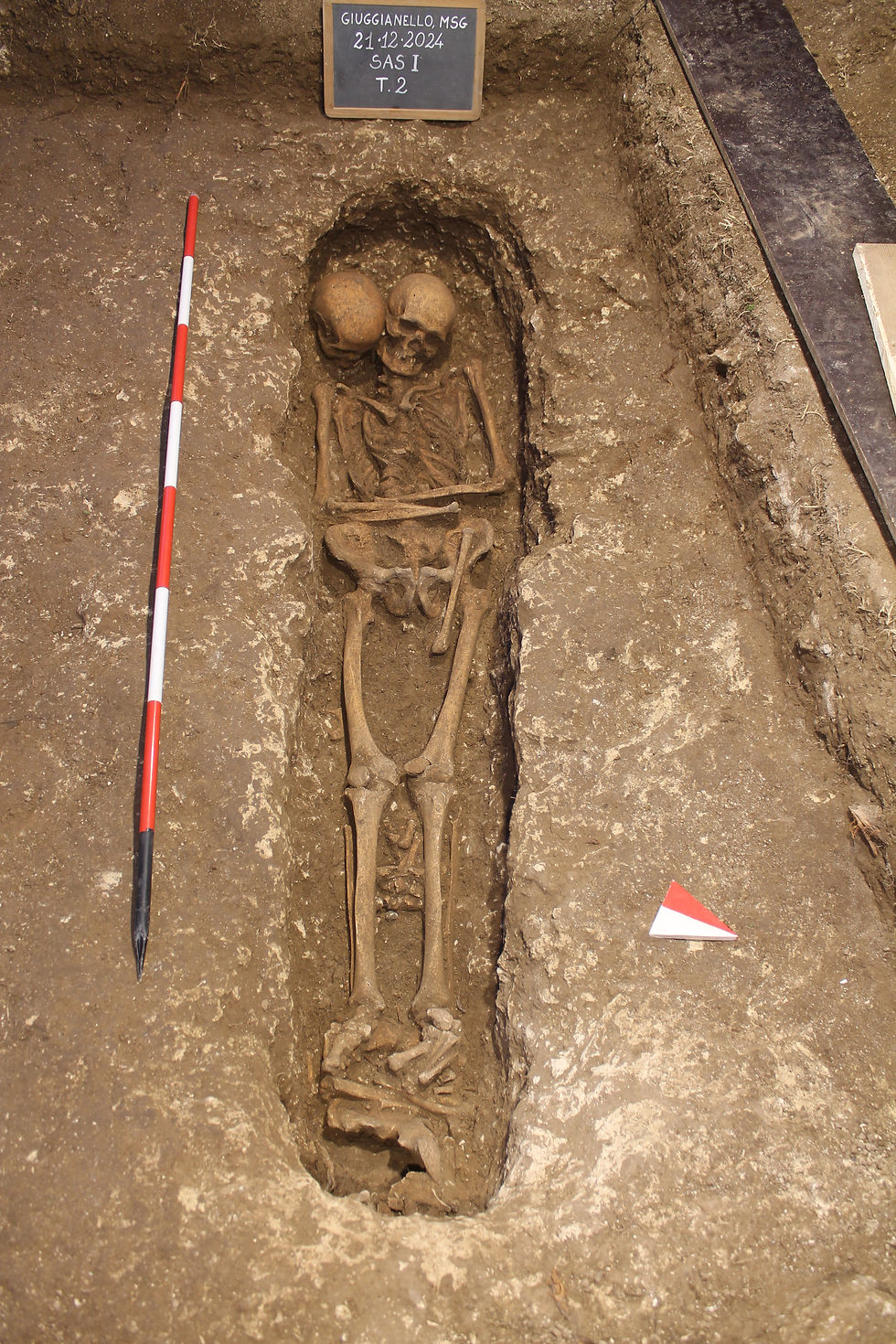
The intervention, directed by the Superintendency (SABAP) of Brindisi and Lecce , highlighted two tombs dug into the rock, containing the skeletal remains of three individuals.
The first burial, occupied by a man aged between 16 and 20 years old, contained a single grave goods item, a ceramic cup, as well as some small fish vertebrae scattered between the thorax and the pelvis.
The excavation of the second tomb, however, revealed an adult buried in a supine position, associated with the disarticulated bones of another skeleton, a young individual, whose remains were set aside, together with the fragments of an uncolored jug, perhaps when it was necessary to make room for the new and final burial.
The shape of the pit, dug into the soft rock bed, is attributable to the "anthropomorphic" type and could recall some examples from the 13th-14th century investigated in various contexts in Salento. However, for a more precise chronological definition, further investigations on the associated finds and the remains discovered are awaited.
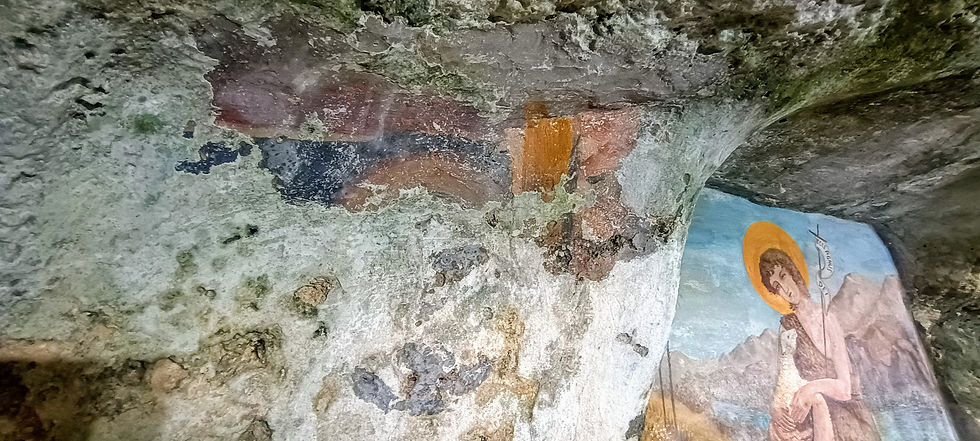
The small rock church, however, can be dated between the 10th and the second half of the 12th century based, respectively, on the discovery of a follis from the time of Constantine VII (905-959) and of the Empress Zoe (ca. 880-920), recovered during the emptying works of the cavity at the end of the 1980s, and on the material and stylistic characteristics of the few surviving fresco fragments inside it.
These Byzantine-era pictorial elements will be the focus of the next interventions, through targeted cleaning and restoration of the surfaces that will breathe new life into the monument's iconographic repertoire.
Undoubtedly, the latest findings expand our existing data and confirm the traces identified in the area following non-invasive investigations conducted in advance since September 2023. They reveal the appearance of a medieval place of worship dedicated to Saint John, associated with a modest burial ground. These remains will remain a key element in the identity of the small community of Giuggianello to this day.
Details of the Finds
The excavations, conducted by archaeologist Luigi Coluccia under the supervision of the Superintendence (SABAP) of Brindisi and Lecce, revealed the presence of a young individual in the first tomb (accompanied by an intact ceramic cup) and a multiple burial in the second tomb (with a fragmented jug). Ground-penetrating radar (GPR) measurements indicate that it may have been a small rural necropolis associated with the underground cult site between the 10th and 14th centuries.
The two tombs were excavated from soft limestone bedrock and have a consistent west-southwest/east-northeast orientation, typical of contemporary Christian burials. Preliminary GPR investigations also revealed additional traces in the subsoil that suggest the presence of a small rural necropolis linked to the church.
Tomb 1 has a characteristic elongated elliptical shape attributable to the "anthropomorphic" grave typology. Inside, it housed the skeleton of an individual in a supine position with his forearms crossed over his chest. Preliminary examination of the bone remains (unfused cartilage and minimal dental wear) suggests that the individual was a young, immature individual, likely a male under 18-20 years of age. The only grave goods recovered from the inhumed individual's feet were an intact, uncolored ceramic cup with a small cylindrical handle. Small vertebrae (perhaps fish) were also recovered between the thorax and pelvis, potential traces of food offerings.
Tomb 2, located approximately 90 centimeters north of Tomb 1 and slightly larger (approximately 2 meters in length), revealed a multiple burial with reuse patterns. It contained the anatomically connected remains of an adult (presumably female) lying on top of the so-called "reduction" of a younger previous occupant. The bones of the latter had been carefully moved and piled along the sides and at the foot of the pit to make room for the new burial. Among the grave goods, fragments of an uncolored ceramic jug with a vertical handle were recovered between the knees of the inhumed woman.
Historical Context and Chronology
The exact dating of the cemetery complex is still being analyzed, but it fits perfectly into the historical events surrounding the rock church of Monte San Giovanni. Although the foundation of the hypogeum can be dated between the 10th century (supported by the previous discovery of a Byzantine coin of Constantine VII and Zoe) and the late 12th century (based on the frescoes), the architecture of the pits directly calls for comparison with other 13th-14th century Salento burials (such as those in Tricase and Ruggiano).
 |  |  |
|---|---|---|
 |  |
The 1990 donation
During the 1990 restoration and cleaning work, five historically significant coins were discovered. The oldest is the Follis, commonly called Follaro, a bronze coin depicting Constantine VII wearing the "loros" (Greek for "loros" - a long scarf with precious stones wrapped around the shoulders, falling in one band at the front, while the other was gathered around the waist and on the forearm. Typical of the emperor and empress, ed.) with a crown and cross, and Zoe at his side. The bronze coin was minted in Constantinople between 914 and 919 and is a typical Byzantine coin equivalent to 40 nummi.
The other coin discovered is the Tournai denarius, a low-alloy silver coin first issued in the early 11th century by the Abbey of Saint Martin in Tours, France. Minted by the Principality of Achaea (also known in the Middle Ages as the Principality of Morea, a vassal state of the Latin Empire that existed from 1210 to 1432, during the Crusades, which included the sacking of Constantinople and the partition of the Byzantine Empire by the princes of the Christian West). This coin began to pass through Italy in the hands of numerous pilgrims and crusaders traveling from France to the Holy Land. The other three coins discovered span a period from 1861 to 1927/28 and therefore date to the Kingdom of Italy.